Saturday, February 18, 2017

The discovery that overturns all knowledge of geography. It was found a new continent Called 'Zealandia'

Topography of Zealandia. The linear ridges running north-northeast and southwest away from New Zealand are not considered part of the continental fragment, nor are Australia (upper left), Fiji or Vanuatu (top centre). Credit: wikipedia

Kids are frequently taught that seven continents exist: Africa, Asia, Antarctica, Australia, Europe, North America, and South America.

Geologists, who look at the rocks (and tend to ignore the humans), group Europe and Asia into its own supercontinent - Eurasia - making for a total of six geologic continents.

But according to a new study of Earth's crust, there's a seventh geologic continent called 'Zealandia', and it has been hiding under our figurative noses for millennia.


Make-up of the 4.9 M km 2 continent of Zealandia in the SW Pacific

The 11 researchers behind the study argue that New Zealand and New Caledonia aren't merely an island chain.

Instead, they're both part of a single, 4.9-million-square kilometre (1.89 million-square-mile) slab of continental crust that's distinct from Australia.


"This is not a sudden discovery but a gradual realisation; as recently as 10 years ago we would not have had the accumulated data or confidence in interpretation to write this paper," they wrote in GSA Today, a Geological Society of America journal.

Ten of the researchers work for organisations or companies within the new continent; one works for a university in Australia.


Zealandia: Earth's Hidden ContinentThis City Knows  Urban Trekkers


But other geologists are almost certain to accept the research team's continent-size conclusions, says Bruce Luyendyk, a geophysicist at the University of California, Santa Barbara (he wasn't involved in the study).


"These people here are A-list earth scientists," Luyendyk tells Business Insider.


"I think they have put together a solid collection of evidence that's really thorough. I don't see that there's going to be a lot of pushback, except maybe around the edges."


Why Zealandia is almost certainly a new continent
N. Mortimer et al./GSA Today


The concept of Zealandia isn't new. In fact, Luyendyk coined the word in 1995.

But Luyendyk says it was never intended to describe a new continent. Rather, the name was used to describe New Zealand, New Caledonia, and a collection of submerged pieces and slices of crust that broke off a region of Gondwana, a 200 million-year-old supercontinent.

"The reason I came up with this term is out of convenience," Luyendyk says.

"They're pieces of the same thing when you look at Gondwana. So I thought, 'why do you keep naming this collection of pieces as different things?'"

Researchers behind the new study took Luyendyk's idea a huge step further, re-examining known evidence under four criteria that geologists use to deem a slab of rock a continent:

Land that pokes up relatively high from the ocean floor

  • A diversity of three types of rocks: igneous (spewed by volcanoes), metamorphic (altered by heat/pressure), and sedimentary (made by erosion)
  • A thicker, less-dense section of crust compared to surrounding ocean floor
  • "Well-defined limits around a large enough area to be considered a continent rather than a microcontinent or continental fragment"

Over the past few decades, geologists had already determined that New Zealand and New Caledonia fit the bill for items 1, 2, and 3.

After all, they're large islands that poke up from the sea floor, are geologically diverse, and are made of thicker, less-dense crust.

This eventually led to Luyendyk's coining of Zealandia, and the description of the region as 'continental', since it was considered a collection of microcontinents, or bits and pieces of former continents.

The authors say the last item on the list - a question of "is it big enough and unified enough to be its own thing?" - is one that other researchers skipped over in the past, though by no fault of their own.

Journey to Zealandia, Earth's Hidden 8th Continent


At a glance, Zealandia seemed broken-up. But the new study used recent and detailed satellite-based elevation and gravity maps of the ancient seafloor to show that Zealandia is indeed part of one unified region.

The data also suggests Zealandia spans "approximately the area of greater India", or larger than Madagascar, New Guinea, Greenland, or other microcontinents and provinces.

"If the elevation of Earth's solid surface had first been mapped in the same way as those of Mars and Venus (which lack […] opaque liquid oceans)," they wrote.

"We contend that Zealandia would, much earlier, have been investigated and identified as one of Earth's continents."


The geologic devils in the details

The study's authors point out that while India is big enough to be a continent, and probably used to be, it's now part of Eurasia because it collided and stuck to that continent millions of years ago.

Zealandia, meanwhile, has not yet smashed into Australia; a piece of seafloor called the Cato Trough still separates the two continents by 25 kilometres (15.5 miles).

N. Mortimer et al./GSA Today
One thing that makes the case for Zealandia tricky is its division into northern and southern segments by two tectonic plates: the Australian Plate and the Pacific Plate.

This split makes the region seem more like a bunch of continental fragments than a unified slab.

But the researchers point out that Arabia, India, and parts of Central America have similar divisions, yet are still considered parts of larger continents.

"I'm from California, and it has a plate boundary going through it," Luyendyk says.

"In millions of years, the western part will be up near Alaska. Does that make it not part of North America? No."

What's more, the researchers wrote, rock samples suggest Zealandia is made of the same continental crust that used to be part of Gondwana, and that it migrated in ways similar to the continents Antarctica and Australia.

The samples and satellite data also show Zealandia is not broken up as a collection of microcontinents, but a unified slab.

Instead, plate tectonics has thinned, stretched, and submerged Zealandia over of millions of years. Today, only about 5 percent of it is visible as the islands of New Zealand and New Caledonia - which is part of the reason it took so long to discover.

"The scientific value of classifying Zealandia as a continent is much more than just an extra name on a list," the scientists wrote.

"That a continent can be so submerged yet unfragmented makes it a useful and thought-provoking geodynamic end member in exploring the cohesion and breakup of continental crust."

Luyendyk believes the distinction won't likely end up as a scientific curiosity, however, and speculated that it may eventually have larger consequences.

"The economic implications are clear and come into play: What's part of New Zealand and what's not part of New Zealand?" he says.

Indeed, United Nations agreements make specific mentions of continental shelves as boundaries that determine where resources can be extracted - and New Zealand may have tens of billions of dollars' worth of fossil fuels and minerals lurking off its shores.

Other articles on the same theme:


Story source: 
 
The above post is reprinted from materials provided by Sciencealert . Note: Materials may be edited for content and length.

Tuesday, February 14, 2017

The ambitious project of the American Natural History Museum through which all the Darwin's manuscripts will be published online

Three quarter length studio photo showing Darwin's characteristic large forehead and bushy eyebrows with deep set eyes, pug nose and mouth set in a determined look. He is bald on top, with dark hair and long side whiskers but no beard or moustache. His jacket is dark, with very wide lapels, and his trousers are a light check pattern. His shirt has an upright wing collar, and his cravat is tucked into his waistcoat which is a light fine checked pattern. Credit: wikipedia
While we can never pick Charles Darwin’s brilliant brain, a collaborative project is bringing us closer to his thoughts than ever before. As of his week, to mark the 155th anniversary of the publication of his iconic book On the Origin of Species, the Darwin Manuscripts Project has made a treasure chest of Darwin’s hand-written notes available online, allowing people across the globe to trace the development of the man that changed the way we look at the world.

The project, which is a collaboration between the American Museum of Natural History (AMNH) and Cambridge University Library, was founded in 2003, and set out to digitize and transcribe a collection of Darwin’s writings. So far, more than 16,000 high resolution images of the naturalist’s notes, scientific writings and sketches have been made publicly available, but the project is only halfway through.

In mid-July 1837 Darwin started his "B" notebook on Transmutation of Species, and on page 36 wrote "I think" above his first evolutionary tree. Credit: wikipedia
The documents hitherto released cover 25 years of Darwin’s life, “in which Darwin became convinced of evolution; discovered natural selection; developed explanations of adaptation, speciation, and a branching tree of life; and wrote the Origin,” according to the AMNH site.

You can even see a drawing by one of Darwin’s children, a scene of carrot and aubergine cavalry, which was sketched on the back of a page of the On the Origin of Species manuscript. You can also see his first use of “natural selection” as a scientific term, among many other things.

By June 2015, the archive will host more than 30,000 documents authored by Darwin between 1835 and 1882. The next release will cover the notes of his eight post-Origin books. The ultimate goal of the project, the AMNH explains, is to provide “access to the primary evidence for the birth and maturation of Darwin’s attempts to explore and explain the natural world.”

Other articles on the same theme:


Story source:


The above post is reprinted from materials provided by Iflscience . Note: Materials may be edited for content and length.

Tuesday, February 7, 2017

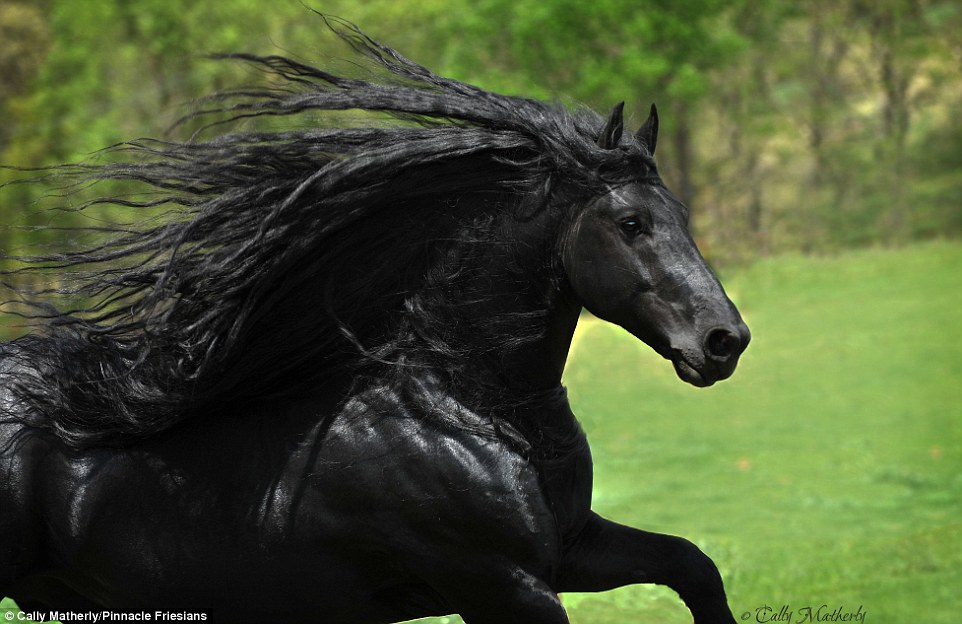
Frederik The Great: The most beautiful stallion in the United States

Mirror mirror on the wall: Frederik is said to be the fairest of them all, with many dubbing him the world's most handsome horse
He's the real life Black Beauty.

And Frederik The Great, a breathtakingly beautiful Friesian stallion from the United States, may just be the world's most handsome horse.

Sharing his name with the ruler of Prussia from 1740-1786, the highly acclaimed horse has a muscular build, striking black features and flowing mane.

Credit: dailymail
The mane attraction: Frederik The Great is a breathtakingly beautiful Friesian stallion from the United States

The beautiful stallion is owned by Pinnacle Friesians where he stands at stud in the Ozark Mountains in the US

With a Facebook fan page of more than 12,500 followers and a blog to his name, the stunning stallion has amassed quite a hefty fan following.


So popular is the horse that an online gallery featuring artwork of him has been created. 

Lustrous locks: 'That hair! It's like someone crossed a horse with the hunky lead from a romance novel,' Boredom Therapy wrote Credit: dailymail
A breathtaking video shot recently shows Frederik galloping freely, with his long black mane billowing in the wind.

'That hair! It's like someone crossed a horse with the hunky lead from a romance novel,' Boredom Therapy wrote. 

The equine treasure's legacy will continue with his first offspring born in August 2015.

Stunning stallion: Frederik is as photogenic as he is handsome 

Vaughn, a Friesian colt, shares the same striking appearance as its father and at just nine months old is completely adorable.

Fans of Frederik The Great have expressed their love for the handsome horse.

'Frederik, you are the most beautiful horse that I have ever seen. Only God could of created such artistry. Breath taking & magnificent,' one person wrote.


'There will NEVER be a more majestic, handsome, sexy horse on the face of the earth. Never, ever. I wish I could just touch and 'smell' him just once,' wrote another. 

Photography by Cally Matherly.

Other articles on the same theme:


Story source: 
 
The above post is reprinted from materials provided by Dailymail . Note: Materials may be edited for content and length.

Deep-sea dragonfish, one of the most bizarre creatures of the Sea - VIDEO

Dragonfish are the stuff of nightmares with their oversized jaws and rows of fanglike teeth. The deep sea creatures may be only several centimeters long, but they can trap and swallow sizeable prey. How these tiny terrors manage to open their mouths so wide has puzzled scientists, until now.

In most fish, the skull is fused to the backbone, limiting their gape. But a barbeled dragonfish can pop open its jaw like a Pez dispenser — up to 120 degrees — thanks to a soft tissue joint that connects the fish’s head and spine, researchers report February 1 in PLOS ONE. 

BIG GULP This X-ray image reveals that a dragonfish has eaten a large lanternfish in a single gulp.
Nalani Schnell of the National Museum of Natural History in Paris and Dave Johnson of the National Museum of Natural History in Washington, D.C., examined preserved specimens of nine barbeled dragonfish genera. 

Five had a flexible rod, called a notochord, covered by special connective tissue that bridged their vertebrae and skulls. When Schnell and Johnson opened the mouths of the fish, the connective tissue stretched out. The joint may provide just enough give for dragonfish to swallow whole crustaceans and lanternfish almost as long as they are.


OPEN WIDE  Some species of dragonfish (Eustomias obscurus shown) open their jaws like Pez dispensers, thanks to a flexible joint at the base of their skulls. The joint may allow the fish to swallow bigger prey, which they trap with their fanglike teeth.

Other articles on the same theme:


Story source: 
The above post is reprinted from materials provided by Sciencenews . Note: Materials may be edited for content and length.

Sunday, February 5, 2017

Amazing Spider Silk properties will lead to the creation of artificial muscles

Our muscles are amazing structures. With the trigger of a thought, muscle filaments slide past each other and bundles of contracting fibers pull on the bones moving our bodies. The triggered stretching behavior of muscle is inherently based in geometry, characterized by a decrease in length and increase in volume (or vice versa) in response to a change in the local environment, such as humidity or heat.

Variations of this dynamic geometry appear elsewhere in nature, exhibiting a variety of mechanisms and structures and inspiring development in artificial muscle technology

Spider silk, specifically Ornithoctonus Huwena spider silk, now offers the newest such inspiration thanks to research from a collaboration of scientists in China and the U.S., the results of which are published today in Applied Physics Letters, from AIP Publishing.


Credit: British Tarantula Society

"Spider silk is a natural biological material with high sensitivity to water, which inspires us to study about the interaction between spider silk and water," said Hongwei Zhu, a professor in Tsinghua University's School of Material Science and Engineering in Beijing and part of the collaboration. "Ornithoctonus Huwena spider is a unique species as it can be bred artificially and it spins silk of nanoscale diameter."

Besides the shrink-stretch ability of muscles, the way in which the motion is triggered -- how the muscle is actuated -- is a key part of its functionality. These spider silk fibers, actuated by water droplets, showed impressive behavior in all the ways that matter to muscle performance (or to super heroes that may need them to swing from buildings).

"In this work, we reveal the 'shrink-stretch' behavior of the Ornithoctonus Huwena spider silk fibers actuated by water, and successfully apply it on weight lifting," said Zhu. "The whole process can cover a long distance with a fast speed and high efficiency, and further be rationalized through an analysis of the system's mechanical energy."

The research team looked at the actuation process in a few different scenarios, capturing the macro dynamics of the flexing fibers with high speed imaging. They actuated bare fibers on a flat surface (a microscope slide) and while dangling from a fixed point (held with tweezers) before adding a weight to the dangling configuration to test its lifting abilities.

Zhu and his group also investigated the micro structure of the proteins that make up the fibers, revealing the protein infrastructure that leads to its hydro-reflexive action.

Electron microscopy gave a clear picture of the smooth inner threads that make up the fibrous structure, and a laser-driven technique, called Raman spectroscopy, revealed the precise conformation of the protein folding structures making up each layer. Fundamentally, the specific molecular configurations, in this case having proteins that have a strong affinity for water and that rearrange in the presence of water, give rise to the spider silk's actuation.

"Alpha-helices and beta-sheets are two types of secondary protein folding structures in spider silk proteins," said Zhu. "Beta-sheets act as crosslinks between protein molecules, which are thought relevant to the tensile strength of spider silk. A-helices are polypeptide chains folded into a coiled structure, which are thought relevant to the extensibility and elasticity in spider silk protein."

Returning the fiber back to its relaxed state (as one-use muscles are far less useful) requires only removing the water, which offers conservation along with its simplicity. With some fine tuning, there is also potential for designing the precise behavior of the shrink-stretch cycle.

"In addition, as the falling water droplet can be collected and recycled, the lifting process is energy-saving and environmentally friendly," said Zhu. "This has provided the possibility that the spider silk can act as biomimetic muscle to fetch something with low energy cost. It can be further improved to complete staged shrink-stretch behavior by designing the silk fiber's thickness and controlling droplet's volume."

Understanding this remarkable material offers new insight for developing any of a number of drivable, flexible devices in the future.

Other articles on the same theme:


Story source:


The above post is reprinted from materials provided by Sciencedaily . Note: Materials may be edited for content and length.

Saturday, February 4, 2017

New Revolutionary mind-reading technology allows immobilized patients to communicate again

Credit: Wyss Centre
The technology to control a computer using only your thoughts has existed for decades. Yet we’ve made limited progress in using it for its original purpose: helping people with severe disabilities to communicate. Until now, that is.

The final stages of the degenerative condition known as amyotrophic lateral sclerosis (ALS) or motor neuron disease, leaves sufferers in a complete locked-in state. In the end they cannot move any part of their bodies, not even their eyes, although their brains remain unaffected.

But scientists have struggled to use brain-computer interface technology that measures electrical activity in the brain to help them communicate.

One reason for this is that it is still unclear how much these conventional brain-computer interface systems rely on electrical signals that are generated by the movement of eye muscles.

One ALS sufferer who had been using a brain-computer interface when she could still move her eyes lost her ability to communicate through the technology after becoming completely locked-in.

This suggested that most of the electrical activity recorded by the computer was related to involuntary eye movements that occurred when she thought about something rather than the thoughts themselves.


To overcome this problem, an international group of researchers used a different way of detecting neural activity that measures changes in the amount of oxygen in the brain rather than electrical signals.

A new study has shown that an alternative brain-computer interface technology can help people with 'locked-in syndrome' speak to the outside world. It has even allowed sufferers to report that they are happy, despite the condition.

The research, published in PLOS Biology, involved a technique known as functional near-infrared spectroscopy, which uses light to measure changes in blood oxygen levels.

Because the areas of the brain that are most active at any given time consume more oxygen, this means you can detect patterns of brain activity from oxygen fluctuations.

This technique is not as sensitive to muscular movements as the electroencephalography (EEG) systems used to measure electrical activity.

An EEG recording setup Credit: wikipedia
This means the new method could be used to help ALS sufferers communicate both before and after they lose their entire ability to move because it is more likely to only record brain activity related to thoughts.

The study involved four ALS sufferers, three of which had not been able to reliably communicate with their carers since 2014 (the last one since early 2015).

By using the new brain-computer interface technology, they were able to reliably communicate with their carers and families over a period of several months. This is the first time this has been possible for locked-in patients.

The volunteers were asked personal and general knowledge questions with known "yes" or "no" answers.

The brain-computer interface captured their responses correctly 70 percent of the time, which the researchers argued was enough to show they didn’t just record the right answer by chance. Similar experiments using EEG didn’t beat this chance-level threshold.

The patients were also able to communicate their feelings about their condition, and all four of them repeatedly answered "yes" when they were asked if they were happy over the course of several weeks.

One patient was even asked whether he would agree for his daughter to marry her boyfriend. Unfortunately for the couple, he said no. The volunteers have continued using the system at home after the end of the study.

As I know from my own research, working with completely locked-in patients requires a lot of hard work. In particular, you can’t know for sure if the user has understood how we want them to give an answer that we can try to detect.

If a system that has previously been used to record the brain activity of able-bodied users doesn’t work with locked-in patients, it is common to assume that the person, and not the machine, is at fault, which may not be the case.

What’s more, there is added pressure on researchers – from the patient’s family and from themselves – to fulfil the dream of finding a way to communicate with the volunteers.

These challenges highlight what a significant achievement the new study is. It is a groundbreaking piece of research that could provide a new path for developing better brain-computer interface technology.

Even though the system so far only allows locked-in patients to give yes or no answers, it already represents a big improvement in quality of life.

The first ever brain-computer interface system was designed to enable disabled (although not locked-in) users to spell words and so communicate any message they wanted, admittedly through a slow and lengthy process.

So it is safe to assume that the new technology is just the first step towards more sophisticated systems that would allow free two-way communication not based on simple questions.

Perhaps more importantly, the technology has already restored the communication capabilities of four people who had been mute for years. Imagine how these patients and their families must have felt when they were finally able to 'speak' again.


Despite the challenges in brain-computer interface research, results like this are what make us keep going.


Other articles on the same theme:


Story source:


The above post is reprinted from materials provided by Sciencealert . Note: Materials may be edited for content and length.

The Biggest Bird in History. It was bigger than a horse and weighed 650 kilograms

Dromornis Credit: thevintagenews
Measuring 3 meters in height and weighing up to 65kg, Dromornis is a genus of prehistoric giant birds. Dromornis  belonged to Dromornithidae,  a family of giant birds that lived 8 million years ago until less than  30,000 years ago. Since millions of years by this time, Australia had been separated from the big southern landmass of Gondwana. Typical for animals in Australia is the fact that they had evolved slowly, completely isolated from the animals of the other continents.


A fossil (cast) of the extinct Dromornis stirtoni from Australia. Photographed at Dinoday 2009 By Kevmin – Own work, CC BY-SA 3.0
Because of the very poor fossil record of  D. australis (the type species of the genus) and a huge time gap between the  two Dromornis species, D. stirtoni may ultimately be reassigned to the genus of Bullockornis.

Sometimes referred to as  “Stirton’s thunder birds” or Mihirung birds, Dromornis stirtoni  was around 3 meters (9.8 ft) tall and weighed up to 650kg. With a long neck and stub-like wings, the giant birds were taller then Aepyornis and heavier than the Moa. Even though Dromornis stirtoni  had really strong and powerful legs it is not believed to have been a fast runner.The bird’s beak was large and immensely strong, leading some researchers to hypothesize that it was a herbivore that used its beak to shear through tough plant stalks.  However, others  theories suggest that the bird was a carnivore, due to the size of the bird’s beak.


D. stirtoni, artist’s impression Photo Credit


Dromornis was sexually dimorphic. Males were more robust and heavier, though not necessarily taller, than females.It inhabited subtropical open woodlands in Australia during the Late Miocene to the early Pliocene. There were forests and a constant water supply at Alcoota, one area where the Dromornis birds lived, albeit the climate was very changeable.


Other articles on the same theme:


Story source:


The above post is reprinted from materials provided by Thevintagenews . Note: Materials may be edited for content and length.

Friday, February 3, 2017

Freemasonry organization against President Donald Trump


article on US presidential elections January 20, 2017 


I m not from the US, still am watching closely what is happening there, simply because America, NATO is still the tip of the sword in everything that means balance and peace in the world. In a democratic world everyone has the right to protest and say their opinion. The problem is that many Americans are just manipulated by the media and these Hollywood stars "controlled by others,"and not only, my opinion is that everything starts from Washington D.C and who really control this city. To answer this question we must go back in time on 1753 when George Washington becomes Master Mason at only 21 years old, later on April 30, 1789, he became 1st President of the United States "Father of the country." 

Read This: From George. Washington to Donald Trump: All 45 presidents of the United States into a single page of History

From that moment Freemasonry organization began to accumulate more and more power, and still continue to do so even today not only in USA. I studied all maps of elections in America's history and I found that something's wrong with Washington D.C. Many elected presidents of America did not have the support of Wasinghton D.C, even if those who had the power remained in those territories. Many of them were assassinated like Lincoln in April 1865 by a Confederate sympathizer?? When we look at the 2016 elections won by Donald Trump we conclude that Washington D.C. and many of Masonic cities were against Donald Trump because he can not be controlled by them compared to Hillary Clinton ( I think that is a good chance for her to be a member of this organization as her husband Bil Clinton


With President Ronald Reagan at White House reception in 1987 Credit: wikipedia

The conclusion is that Freemasonry use all their power and all the people controled by them, including many of Hollywood stars and artists to raise people in the street and destroy the image of Donald Trump.


For the first time in the History of America is not how they want.

All article writed by me thank you

Congratulations to Donald Trump.

Scientists have created new forms of life containing '' Artificial DNA'' This could be the beginning of a whole new life form.

Credit: Kateryna Kon
Scientists have engineered the first ever 'semi-synthetic' organisms, by breeding E. coli bacteria with an expanded, six-letter genetic code.

While every living thing on Earth is formed according to a DNA code made up of four bases (represented by the letters G, T, C and A), these modified E. coli carry an entirely new type of DNA, with two additional DNA bases, X and Y, nestled in their genetic code.

The team, led by Floyd Romesberg from the Scripps Research Institute in California, engineered synthetic nucleotides - molecules that serve as the building blocks of DNA and RNA - to create an additional base pair, and they’ve successfully inserted this into the E. coli’s genetic code.

Credit: samsunkenthaber

Now we have the world’s first semi-synthetic organism, with a genetic code made up of two natural base pairs and an additional 'alien' base pair, and Romesberg and his team suspect that this is just the beginning for this new form of life.

"With the virtually unrestricted ability to maintain increased information, the optimised semi-synthetic organism now provides a suitable platform  to create organisms with wholly unnatural attributes and traits not found elsewhere in nature," the researchers report.

"This semi-synthetic organism constitutes a stable form of semi-synthetic life, and lays the foundation for efforts to impart life with new forms and functions."

Back in 2014, the team announced that they had successfully engineered a synthetic DNA base pair - made from molecules referred to as X and Y - and it could be inserted into a living organism.


Since then, they’ve been working on getting their modified E. coli bacteria to not only take the synthetic base pair into their DNA code, but hold onto it for their entire lifespan.

Initially, the engineered bacteria were weak and sickly, and would die soon after they received their new base pair, because they couldn’t hold onto it as they divided.

Credit: Wonderwhizkids

"Your genome isn't just stable for a day," says Romesberg. "Your genome has to be stable for the scale of your lifetime. If the semisynthetic organism is going to really be an organism, it has to be able to stably maintain that information."

Over the next couple of years, the team devised three methods to engineer a new version of the E. coli bacteria that would hold onto their new base pair indefinitely, allowing them to live normal, healthy lives.

The first step was to build a better version of a tool called a nucleotide transporter, which transports pieces of the synthetic base pair into the bacteria’s DNA, and inserts it into the right place in the genetic code. 

"The transporter was used in the 2014 study, but it made the semisynthetic organism very sick," explains one of the team, Yorke Zhang.

Once they’d altered the transporter to be less toxic, the bacteria no longer had an adverse reaction to it.

Next, they changed the molecule they’d originally used to make the Y base, and found that it could be more easily recognised by enzymes in the bacteria that synthesise DNA molecules during DNA replication.

Finally, the team used the revolutionary gene-editing tool, CRISPR-Cas9 to engineer E. coli that don’t register the X and Y molecules as a foreign invader.

The researchers now report that the engineered E. coli are healthy, more autonomous, and able to store the increased information of the new synthetic base pair indefinitely.

"We've made this semisynthetic organism more life-like," said Romesberg.

If all of this is sounding slightly terrifying to you, there's been plenty of concern around the potential impact that this kind of technology could have.


Back in 2014, Jim Thomas of the ETC Group, a Canadian organisation that aims to address the socioeconomic and ecological issues surrounding new technologies, told the New York Times:

"The arrival of this unprecedented 'alien' life form could in time have far-reaching ethical, legal, and regulatory implications. While synthetic biologists invent new ways to monkey with the fundamentals of life, governments haven’t even been able to cobble together the basics of oversight, assessment or regulation for this surging field."

And that was when the bacteria were barely even functioning. 

But Romesberg says there's no need for concern just yet, because for one, the synthetic base pair is useless. It can't be read and processed into something of value by the bacteria - it's just a proof-of-concept that we can get a life form to take on 'alien' bases and keep them.

The next step would be to insert a base pair that is actually readable, and then the bacteria could really do something with it.

The other reason we don't need to be freaking out, says Romesberg, is that these molecules have not been designed to work at all in complex organisms, and seeing as they're like nothing found in nature, there's little chance that this could get wildly out of hand.

"[E]volution works by starting with something close, and then changing what it can do in small steps," Romesberg told Ian Sample at The Guardian.

"Our X and Y are unlike natural DNA, so nature has nothing close to start with. We have shown many times that when you do not provide X and Y, the cells die, every time."


Time will tell if he's right, but there's no question that the team is going to continue improving on the technique in the hopes of engineering bacteria that can produce new kinds of proteins that can be used in the medicines and materials of the future.


The research has been published in Proceedings of the National Academy of Sciences.


Other articles on the same theme:


Story source: 
The above post is reprinted from materials provided by Sciencealert . Note: Materials may be edited for content and length.